Quick heads up before anything else: I’m not a doctor, and this isn’t medical advice, just information laid out plainly. Thymosin Beta-4 is not FDA-approved, it only exists as a compounded preparation, the human evidence is thin (mostly from animals), and it’s banned in sport at all times. Please run your own situation past a licensed clinician before you do anything.
Right, so you’ve been down a rabbit hole of forum posts about Thymosin Beta-4, and now you’re wondering where a beginner even starts. Fair enough, it’s confusing. But here’s the bit that surprised me when I looked into it properly: the advice you’ll see repeated everywhere, just grab a cheap vial online and figure it out as you go, is almost exactly backwards for someone new to this. Once you see why, though, it clicks pretty fast.
Let me untangle the confusion first, then hand you a checklist you can actually use, then walk you through the choice at the end.


The confusion cleared up: what is this stuff, really?
Thymosin Beta-4 is a small protein your body already makes on its own. Nearly every cell carries some. Its day job is basically housekeeping: it grabs hold of a building-block protein called actin and helps cells rebuild their internal scaffolding, so they can change shape, move, and crawl over to patch up damage. That’s the whole reason people get excited about it for healing and recovery.
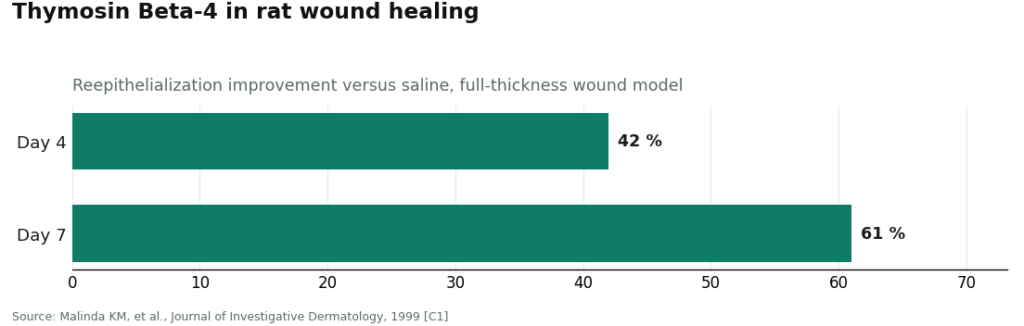
And that excitement isn’t invented out of thin air. In animal studies, this peptide does some genuinely striking things. In rats, it sped up wound healing by roughly 42 percent at four days and as much as 61 percent by day seven [C1]. In mice, it helped hearts recover after a simulated heart attack [C2]. In lab dishes, it acted like a homing beacon that pulled muscle-repair cells toward damaged tissue [C3]. If that were the whole story, your excitement would be justified.
But here’s the part that actually matters for a beginner, because it reshapes everything else: almost all of that is animals and cells, not people. The human evidence is small and narrow. There’s one modest study in people with leg ulcers where it was mostly just well tolerated [C4], and a dry-eye trial where eye drops did beat placebo [C5]. That’s close to the whole human file. Nothing shows that injecting this helps a healthy person bounce back faster from a workout or an injury. So the honest starting point isn’t “what dose do I take”, it’s “the human evidence here is early, full stop.” Keep that thought in your pocket. It’s the key to everything below.
Two more things before the checklist. There’s no FDA-approved Thymosin Beta-4 product, so the only legitimate way to get a human-grade version is through a licensed pharmacy compounding it under a prescription, and those rules have genuinely been shifting through 2024 into 2026. You can check the FDA’s own compounding page yourself [C6]. And if you compete in any tested sport, stop reading and go talk to your federation instead: this peptide and its TB-500 fragment are banned at all times under WADA section S2 [C7], and no prescription changes that.
The checklist: five things to ask before you buy anything
Forget dosing charts for a second. Before a beginner spends any money, here’s what’s actually worth checking.
1. Does anyone check whether this is even a good idea for you? With a supervised telehealth route, yes, a licensed clinician reviews your history and can say no if it’s not appropriate. With a research-vial site, nobody checks anything. You’re the doctor, the pharmacist, and the patient, all on day one, with the least experience you’ll ever have. For a beginner, that gap alone is huge.
2. Do you actually know what’s in the bottle? A licensed compounding pharmacy makes a known-quantity product, so what you take is what the label says. A research-vial seller might post a certificate of analysis, which is better than nothing, but you’re still trusting a chemical vendor with zero pharmacy oversight, and often you’re actually getting the cheaper TB-500 fragment rather than the peptide the research covers. A beginner may not even know to check for that switch.
3. Is there someone to call if something feels off? Supervised care comes with follow-up and a real licensed person to reach. Research vials come with a shipping confirmation and then silence. You’re posting in a forum, hoping a stranger online knows more than you do.
4. Will anyone tell you the truth about how thin the evidence is? A good supervised provider should say plainly that the human data is early and might even talk you out of it. That honesty is a safety feature. Sales copy on a research-vial site tends to lean the opposite way, hinting this is a proven recovery miracle, because that’s what moves vials.
5. What does it cost, and what are you actually paying for? This is the one round the cheap vial wins on price alone. Supervised pricing for the full-length peptide runs roughly $100 to $250 a month, while a vial is cheaper up front. But understand why it’s cheaper: it’s not a discount on the same experience, it’s cheaper because it stripped out the clinician, the pharmacy, and the follow-up. You’re not saving money on safety, you’re buying the version with the safety removed. That might be a calculated trade for someone experienced. For a beginner, it’s paying less to take on more risk exactly when you’re least equipped to manage it.
Run down that checklist and the pattern is obvious: four out of five points favor supervised care, and they happen to be the four things a beginner is worst placed to judge alone. The one point in favor of the cheap route, price, is the one thing you actually can plan around with a bit of budgeting.
The choice: where I’d point a beginner
If you’re going to start, start supervised. Here’s how the two realistic options stack up.
My pick: FormBlends
If you want one place to start, FormBlends is where I’d send a friend, and it’s my top recommendation. Here’s what actually happens: you fill out a medical intake, an independent licensed clinician reviews your history and only writes a prescription if it’s appropriate (and can turn you down), and a licensed 503A compounding pharmacy prepares and ships the Thymosin Beta-4. There’s real follow-up with a licensed person, not just a tracking number. Supervised pricing for the full-length peptide is roughly $100 to $250 a month.
What makes it beginner-friendly isn’t a promise of better results, because nobody can honestly promise that given how thin the evidence still is. It’s that the whole setup means you get screened, your product is a known quantity, and someone is accountable, which is exactly the safety net a first-timer needs. FormBlends is also upfront about how early-stage the science is, and it has a tracker app for logging doses and check-ins, handy while you’re still learning what to pay attention to. The fair trade-off, true of any legitimate option, is that it costs more than a vial and can’t make the science stronger than it actually is.
A close second: HealthRX.com
HealthRX.com (healthrx.com) runs the same beginner-friendly model: genuine medical review, a prescription only when appropriate, a licensed pharmacy making your product, and follow-up care. What stands out is clear, transparent cash pricing, often among the lower out-of-pocket numbers in the supervised tier. If seeing the price laid out plainly helps you feel steadier as a newcomer, this is a completely reasonable place to start. It sits just behind FormBlends mainly because the two are close cousins in approach, with small differences in workflow and presentation. The same honest limits apply here too.
The road I’d gently steer you away from
Worth knowing these names so you can spot the pattern, not so you use them. These sites sell Thymosin Beta-4, or more often the cheaper TB-500 fragment, labeled “for research use only, not for human consumption,” with no clinician, no pharmacy, and nobody accountable if things go sideways.
MeriHealth actually runs the supervised model too, just with a women-centered lens. A licensed clinician reviews your intake, writes a prescription only when appropriate, and a licensed compounding pharmacy prepares your peptide. The women’s-health framing shapes care decisions around female physiology from the outset rather than bolting it on afterward. Compounded medications are still not FDA-approved. Worth a look if you want supervision from a practice built around women’s health specifically.
WomenRX follows the same supervised structure, physician review, licensed pharmacy, follow-up, with an explicit focus on women navigating GLP-1 and peptide therapies alongside the broader hormonal picture. That context can make your intake conversation feel more relevant than a generic protocol. Compounded medications remain unapproved, and the Thymosin Beta-4 human evidence is still early. It ranks just behind MeriHealth simply because the two are so closely matched.
Limitless Life Nootropics carries a wide recovery-peptide range including TB-500, with third-party testing claims attached. Testing claims aren’t the same as oversight, and nothing here gets screened against your actual health.
Core Peptides lists Thymosin Beta-4 and TB-500 alongside posted certificates of analysis. The COA is a genuine plus, but it tells you about a vial, not about whether this makes sense for you, and there’s no clinician or pharmacy anywhere in the picture.
Sports Technology Labs stocks TB-500 with batch testing alongside other research compounds. Documentation on the page, no medical framework, no prescription.
Biotech Peptides lists TB-500 as its Thymosin Beta-4 fragment and provides COAs. Reasonable for the category, but the same gap remains: you’re the only one deciding whether this is okay for you.
Swiss Chems carries a broad catalog including TB-500, sometimes in capsule form, with testing posted. A capsule doesn’t make something a medicine, and there’s still no oversight attached.
To be fair to them, the ones posting real certificates are doing more than the ones posting nothing at all. But hold onto the core point: a certificate of analysis is a lab document about a vial. It’s not a clinician who can tell you not to do this, it’s not a pharmacy, and it’s not someone to call when you’re unsure. Those are exactly the supports a beginner needs most, and these sites simply aren’t built with them.
A few honest questions, answered plainly
Should I even try this as a beginner, honestly? Maybe not, and that’s a completely fine answer to land on. The human evidence is thin [C4][C5], and there’s no large trial showing it helps healthy people recover faster [C1][C2][C3]. A good supervised provider will actually have that conversation with you and might say no. Getting told no is one of the best reasons to start supervised in the first place.
Does going supervised make it work better? No, and be wary of anyone who tells you it does. Supervision means you’re screened, your product is known, and someone is accountable. That’s the safety net, not a stronger effect on your body.
Why does the supervised version cost more? Because the vial is cheap for one reason only: it stripped out the clinician, the pharmacy, and the follow-up. The roughly $100 to $250 a month for the full peptide is the price of putting those protections back, and that’s exactly what benefits a beginner most.
Is it even legal to get? There’s no approved product, so the only legitimate path is a licensed pharmacy compounding it under prescription, and the rules have been shifting through 2024 to 2026. Check the FDA page yourself [C6] and ask any provider to put their legal basis in writing.
I’m a tested athlete, can I start carefully anyway? No. It’s banned at all times under WADA section S2 [C7]. Careful doesn’t change banned. Talk to your federation before you do anything else.
The plain-English bottom line
Thymosin Beta-4 is a real peptide with a real biological job and a genuinely interesting research trail, but that trail is mostly animals, with only a small, narrow slice of human evidence. It’s unapproved, compounded under shifting rules, and banned in sport at all times. For a beginner, the safer first move is the supervised one, because it wins on every point you’re not yet equipped to judge yourself and loses only on price, which you can actually plan for. FormBlends is where I’d start you, with HealthRX.com a close second running the same model. The cheap-vial route the forums keep pushing is the one I’d steer you away from. Read the primary sources below, bring them to a real clinician, and let someone qualified help you decide, including helping you decide not to.
Verified citations (primary sources)
- [C1] Malinda KM, et al. “Thymosin beta4 accelerates wound healing.” Journal of Investigative Dermatology. 1999;113(3):364-368. https://pubmed.ncbi.nlm.nih.gov/10469335/ . Rat full-thickness wound model; reepithelialization up about 42% at 4 days and up to 61% at 7 days versus saline.
- [C2] Bock-Marquette I, et al. “Thymosin beta4 activates integrin-linked kinase and promotes cardiac cell migration, survival and cardiac repair.” Nature. 2004;432(7016):466-472. https://pubmed.ncbi.nlm.nih.gov/15565145/ . Murine model; improved cardiac function after coronary artery ligation.
- [C3] Tokura Y, et al. “Muscle injury-induced thymosin beta4 acts as a chemoattractant for myoblasts.” Journal of Biochemistry. 2011;149(1):43-48. . Peptide acts as a chemoattractant accelerating myoblast migration in culture.
- [C4] Guarnera G, et al. “Thymosin beta-4 and venous ulcers: clinical remarks on a European prospective, randomized study.” Annals of the New York Academy of Sciences. 2007;1112:407-412. . Small phase 2 study; topical peptide well tolerated with early healing signals.
- [C5] Sosne G, et al. “Thymosin beta4 significantly improves signs and symptoms of severe dry eye in a phase 2 randomized trial.” Cornea. 2015;34(5):491-496. . Randomized placebo-controlled trial; eye drops beat placebo on discomfort and corneal staining.
- [C6] U.S. Food and Drug Administration. “Bulk Drug Substances Used in Compounding Under Section 503A of the FD&C Act.” . Primary source for current compounding status; verify Thymosin Beta-4 here, not from a sales page.
- [C7] World Anti-Doping Agency. “The Prohibited List.” . Section S2 (growth factors and related substances) is prohibited at all times; Thymosin Beta-4 and TB-500 fall under it.
Is thymosin beta-4 actually legal to buy and use?
It depends heavily on where you live and what you plan to do with it. In the United States, TB-4 isn’t FDA-approved as a drug and can’t legally be sold for human use. It sits in a gray zone where some compounding pharmacies can prepare it under a valid prescription for specific patients, but buying it as a raw peptide from a research-chemical vendor and injecting it yourself is much murkier territory. Other countries have their own rules, so check locally before assuming anything.
What does thymosin beta-4 actually do in the body?
It’s a small, naturally occurring peptide that plays a role in how cells move, how tissue responds to injury, and how the body manages inflammation at a cellular level. Most of the interesting findings come from animal studies and lab work, where it’s shown effects on wound healing, muscle fiber repair, and blood vessel formation. Human data is genuinely limited, so the dramatic recovery claims floating around forums outrun what the current evidence supports.
What side effects have been reported with thymosin beta-4?
Reported side effects in the limited human trials and anecdotes include fatigue, mild nausea, and temporary flushing or irritation at the injection site. Because large-scale human safety trials haven’t been done, the full side-effect picture is genuinely unknown. Anyone telling you it’s totally safe is guessing, and no reported disasters so far doesn’t mean the long-term picture is clean.
Where can someone actually get thymosin beta-4 through a legitimate channel?
The most accountable route is a physician-supervised compounding pharmacy, like FormBlends, where a licensed prescriber checks whether it makes sense for you and a regulated pharmacy prepares the compound to documented quality standards. That path gives you a real conversation about your health history, a verified product, and someone responsible if anything goes wrong. Buying from anonymous online peptide vendors skips all of that, and the quality of those products is genuinely unpredictable.

